Here’s Aswar’s full story.
The extraordinary task of prosecuting and abolishing ICE, rebuilding our refugee and immigration systems to last, and bringing federal funding back to the East Metro will take an extraordinary person. Here’s Aswar’s full story, so you can judge whether or not he is the person you would want as your Representative in Congress.
An immigrant kid.
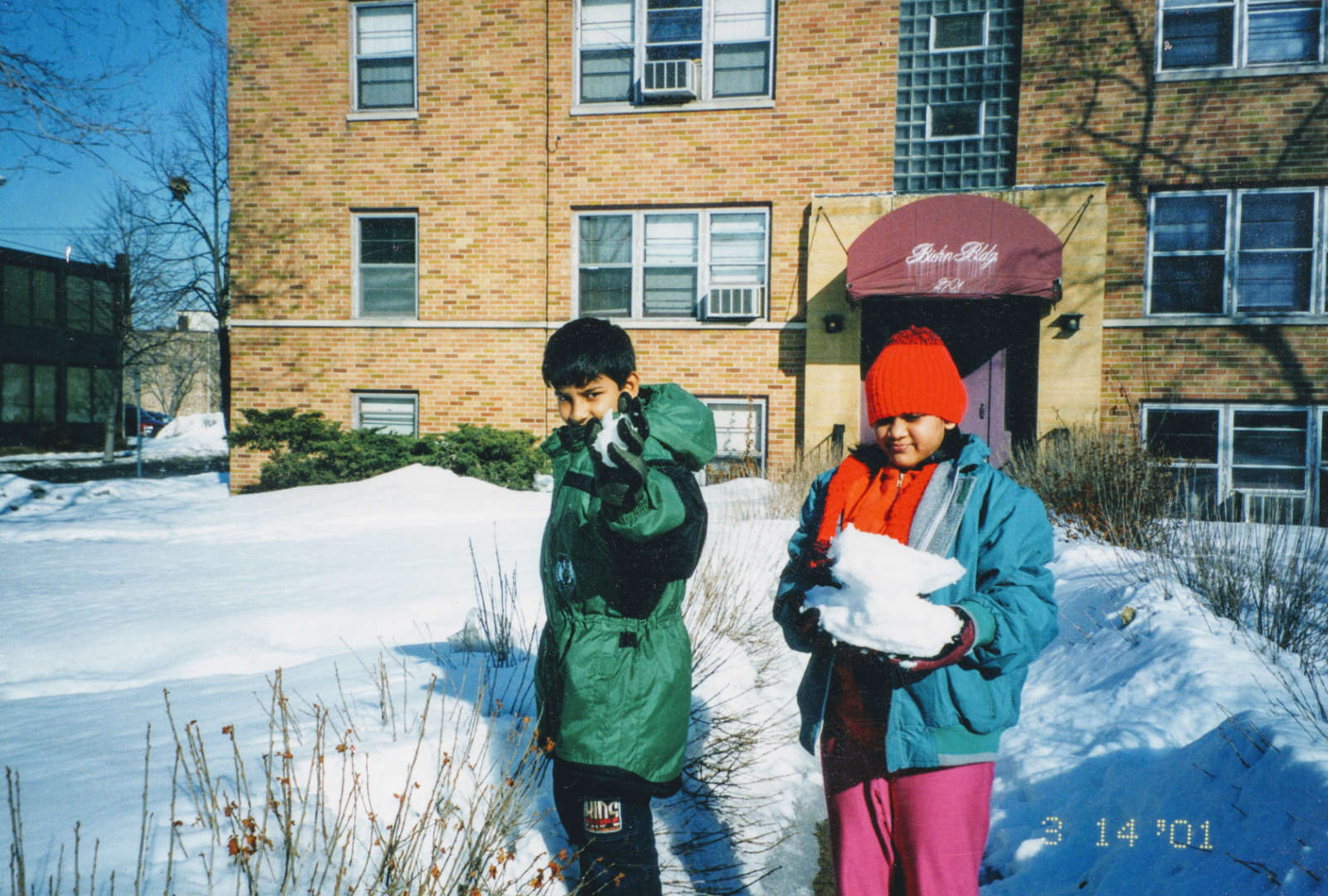
Aswar, his mom, and his sister got to Minnesota from Bangladesh in the middle of February 2001. Aswar’s brother, a brilliant student, made it to Minnesota first on a merit scholarship that turned into a job at Wells Fargo.
The family lived in basement apartments for several years in South Minneapolis. The public schools were a lifeline for Aswar and his family. Teachers at Longfellow Elementary (now Longfellow Alternative High School) embraced the family and even supported in finding housing and work for Aswar’s mom. That job with the Minneapolis Public Schools led to permanent residency and, after many years of struggle, citizenship.
Aswar’s mom eventually saved up enough to buy a home and start a clothing and tailoring business on Central Avenue, a mecca for Minnesota’s immigrant businesses. After the 2008 recession hit, the family lost their home to foreclosure.
Off to college at 16.
Aswar was at Minneapolis Southwest High School when they lost their home. A national-level debate champion and football defensive end, he started looking for work to support his family. His mom wouldn’t hear of it — he could only get a job if he had a college degree. So, Aswar made plans to go off to college as fast as he could.
A college in the mountains of Santa Fe decided to take him up on his offer, so at 16 years old, he set off to college. Soon, the University of Minnesota expressed interest in him, so he transferred, and at 19 had his Bachelors.
A passion for filmmaking that turned into an impactful business.
Aswar didn’t have many male role models growing up, so he turned to movies to do is best to learn about the world as a man. Endless hours at the Riverview Theater in South Minneapolis turned into a passion for filmmaking.
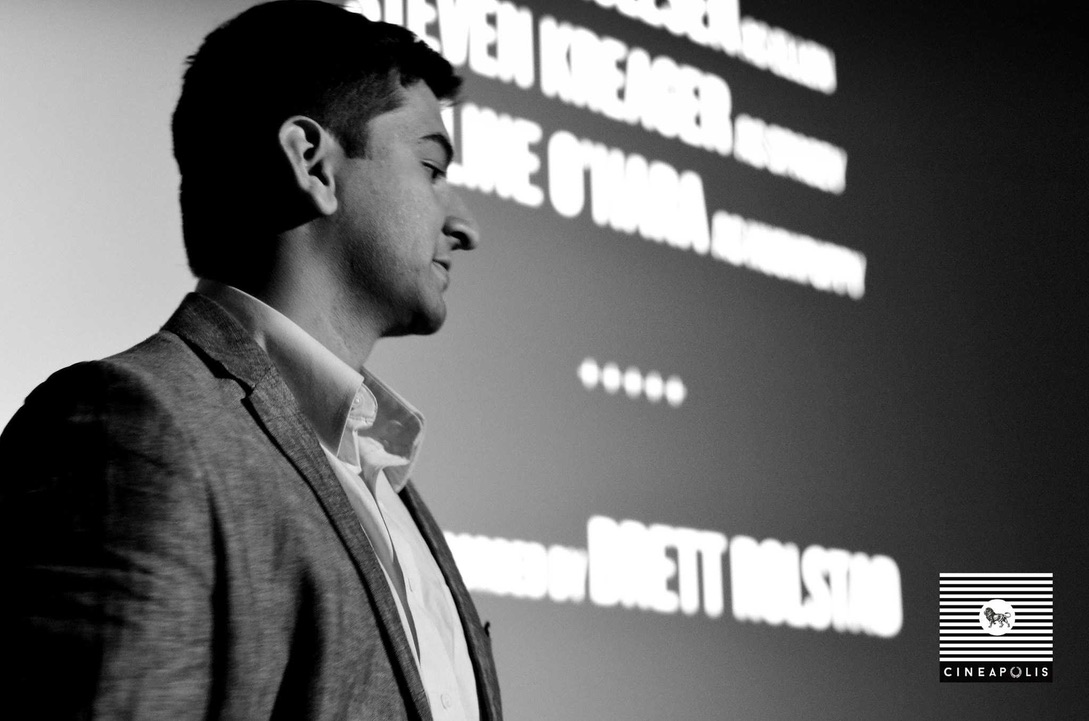
While at the University of Minnesota, Aswar won awards for his short films. He pivoted to feature filmmaking, and started the first feature film collective in Minnesota, Cineapolis.
With his family still reeling from the Great Recession, Aswar needed to earn, and so he put his filmmaking ability to business use, making videos for a wide range of companies, from small Minneapolis nonprofits, all the way up to massive companies like Honda. Business was good.
(Here’s Aswar’s current filmography on IMDb.)
The first Trump catastrophe, and turning to electoral politics.
When Donald Trump first started making headlines for his attacks on Americans from Muslim-majority countries, Aswar got mobilized. When Trump came to Minnesota for his first big rally, Aswar was among the handful of people who went out to protest. (Here is an MPR article from the day — in a photo in the article, Aswar is holding an American flag that he borrowed from his friend’s dad on the way to protest.)
When Trump was elected, Aswar made a vow to his then-girlfriend (now-wife) Rachel that he would do something — anything — to fight back.
Aswar knew that electoral politics allowed this to happen, and that would be where the big struggle would need to happen. So, he assembled his company staff and informed them that rather than focusing on corporate and nonprofit work, we would be focusing on getting Democrats elected.
Headfirst into Democratic campaigns.
Immediately after Trump’s first election, the Democratic political world was in chaos. Most frustrating to Aswar, however, was that there weren’t any political campaigns for his team to work on. So, he started his own — his 2017 run for Mayor of Minneapolis, built on the issues that he cared about most: economic opportunity for the people of his city; free college tuition at Minneapolis college; and a shift in city funding from vanity infrastructure projects to anti-poverty and economic empowerment campaigns. (Here’s a video from the first mayoral forum on the Uptake.)
Aswar met over 100,000 people in his race, but his lack of fundraising experience combined with his age — just 23 at the time — made it unlikely he could pull of a win. So, he spoke with all the other candidates and chose to support the one that most aligned at the time with his vision for the city: Jacob Frey.
A meteoric rise in digital politics.
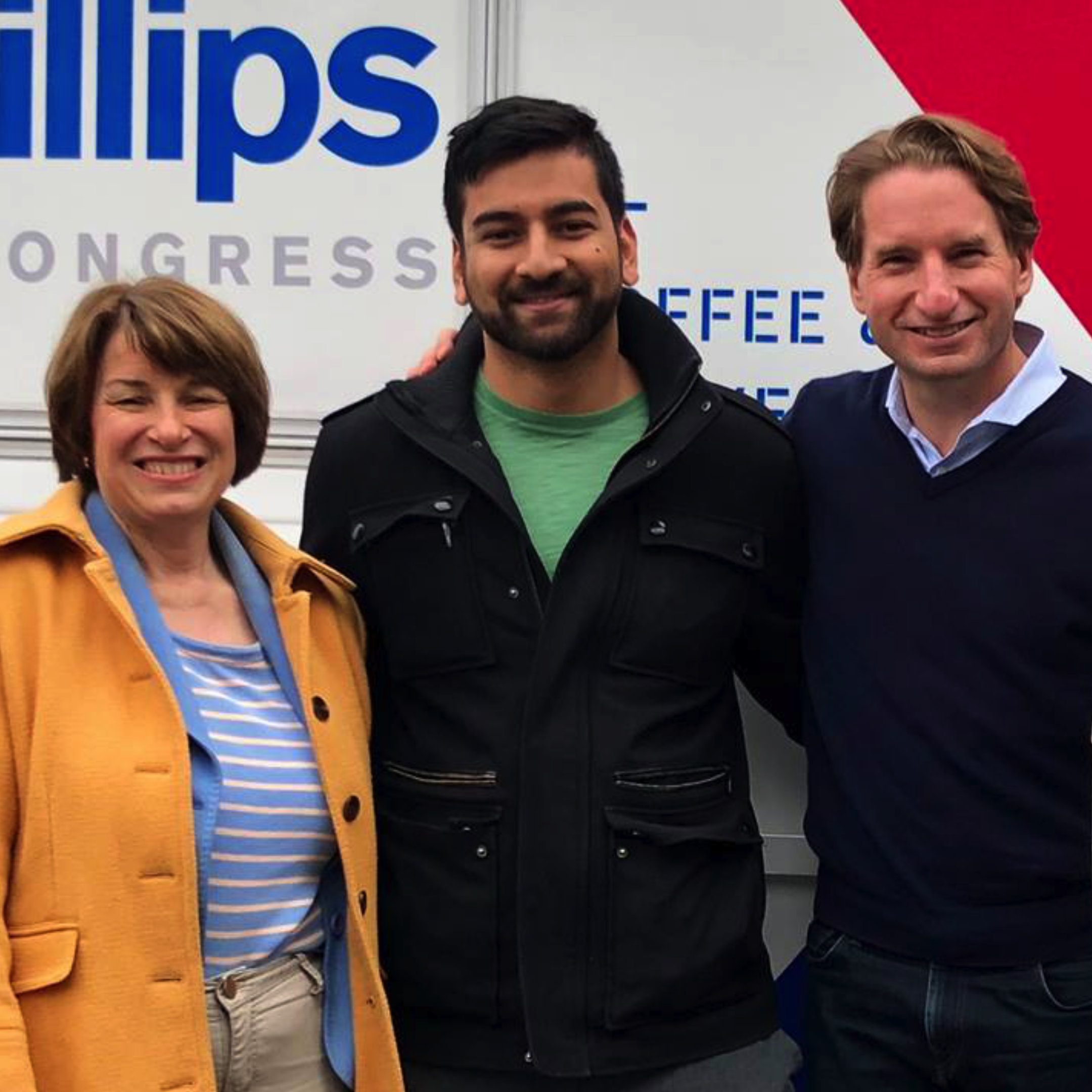
Though the campaign lost, Aswar’s mission won. Because of how boldly he ran his campaign, Aswar and his team became highly in-demand for Democratic Congressional and Presidential campaigns. Without losing a beat, he became Digital Director for the DFL campaign to win back Minnesota’s Third District (the West Metro of the Twin Cities) that had been in Republican control since the Korean War. In Dean Phillips’ winning campaign, Aswar helped lead what some national experts called the most innovative digital strategy in any campaign during those crucial 2018 midterms.
(By the way, around this time, Aswar got called up by the Bravo Network to go to rural America to be part of the Welcome to Waverly miniseries. He keeps in touch with friends from Waverly, Kansas, population 570 — to this day.)
After Dean, Aswar was enlisted by Senator Amy Klobuchar’s team as their Digital Content Director. This exposed Aswar to national level politics, and raised his profile among D.C.-based organizations. After Senator Klobuchar’s withdrawal from the 2020 presidential race, Aswar joined on as the digital lead for the largest coalition of pro-democracy organizations in America: the Declaration for American Democracy.
With a successful digital business humming along and Trump out of the White House, Aswar felt he could breathe easy. He started making movies again, even spending a year out in Los Angeles, producing films.
A calling to help Ukraine.
Russia’s full-scale invasion of Ukraine in February 2022 shook Aswar to his core. When he heard that schoolteachers were picking up guns to defend Kyiv against a murderous army, he couldn’t sleep, thinking of the courage of these people, and the price they would undoubtedly have to pay — and the service they were doing for freedom in the world by standing up to these monsters.
There was also news of abuse in the refugee crisis that this invasion created. Millions of Ukrainians — mainly moms and their kids and grandparents — were fleeing the Russian onslaught in the largest refugee crisis since World War II. Many of them, desperate for safety, accepted help from shadowy figures waiting for them at the Polish border. Many of those who accepted help haven’t been heard from since.
Standing on Santa Monica Pier, Aswar decided that doing nothing was not an option. He got his gear together, bought a good pair of waterproof boots, and got on the next flight to Poland. He drove down to the main border crossing with Ukraine and, seeing the massive stream of refugees at the border, got right to work.
First, Aswar simply carried bags. Many of the refugees were on the edge of collapse from exhaustion, especially the elderly who had been traveling with little food, water, medicine, and hope of seeing their homes ever again. For eight hours a day, Aswar would carry bags at the border, and then go to his small rented room in the nearest town to continue leading his business.
Aswar’s consistency and effort got the attention of humanitarian groups looking to bring order to the chaotic camp receiving this flow of refugees. First, he helped build medical clinics at the crossing. When word got out that Aswar did digital for the Democrats, he was assigned a new task: designing for the entirety of the camp.
Through rapid graphic design and mapmaking, Aswar was able to help get this Polish-side camp in order. The thousands of refugees arriving every day were greeted with a disciplined system that got medical attention to those who needed it, baby-care services to moms, and transportation and shelter options to all arrivals, whether they had any connections in Poland or not.
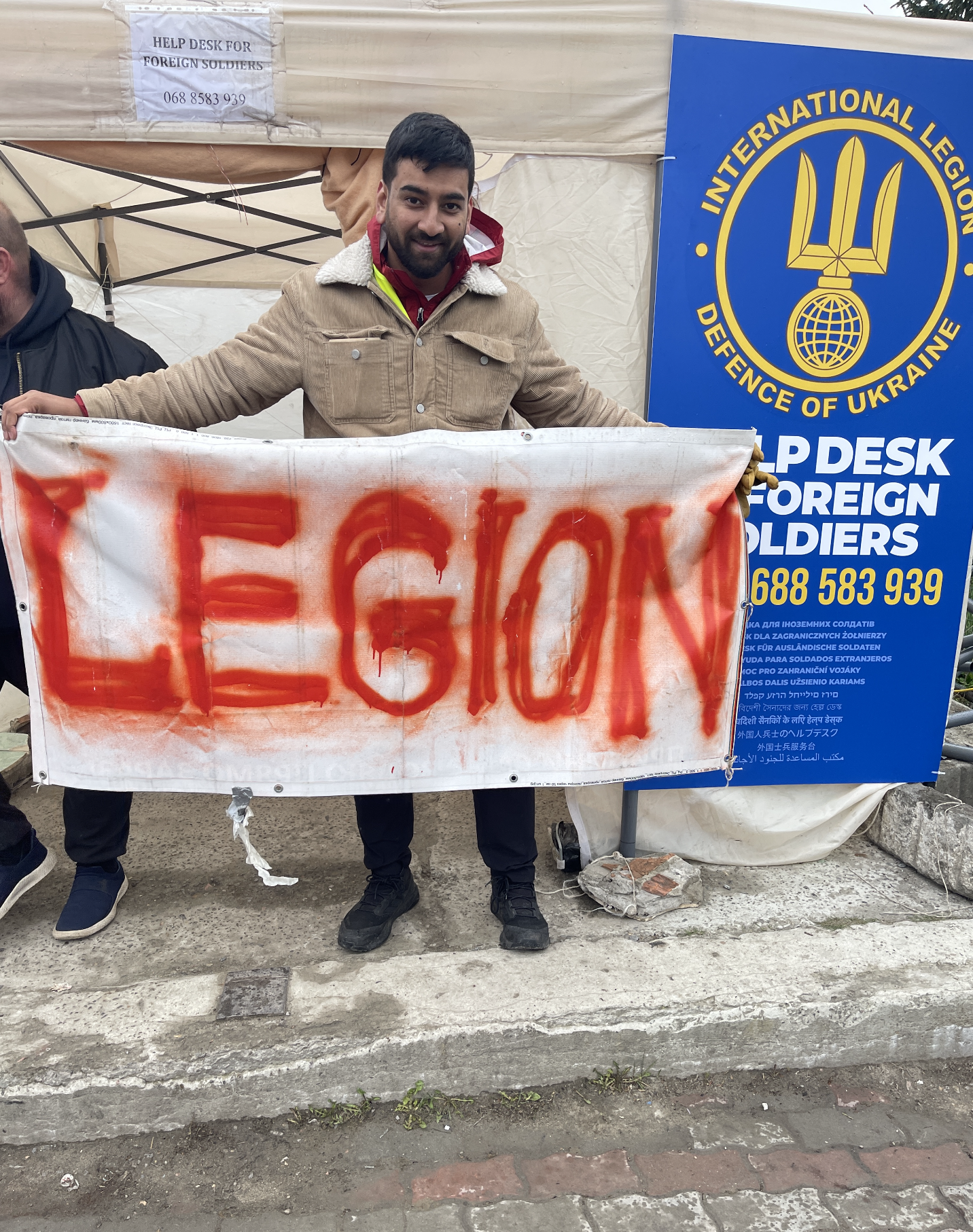
Word of Aswar’s work on the Polish side of the crossing got to the humanitarian workers on the Ukrainian side of the crossing, where the need was exponentially greater. So, with Rachel’s permission, Aswar crossed the border into Ukraine, at a time when Russian troops were on the verge of capturing Kyiv.
The only American refugee office in Lviv.
Aswar quickly got to work supporting the humanitarian workers — mostly Poles — who had taken on the task of helping refugees fleeing the front lines of Russia’s attack. Aswar did what he did before and helped design the humanitarian camp on the Ukrainian side of the crossing, just as he did on the Polish side.
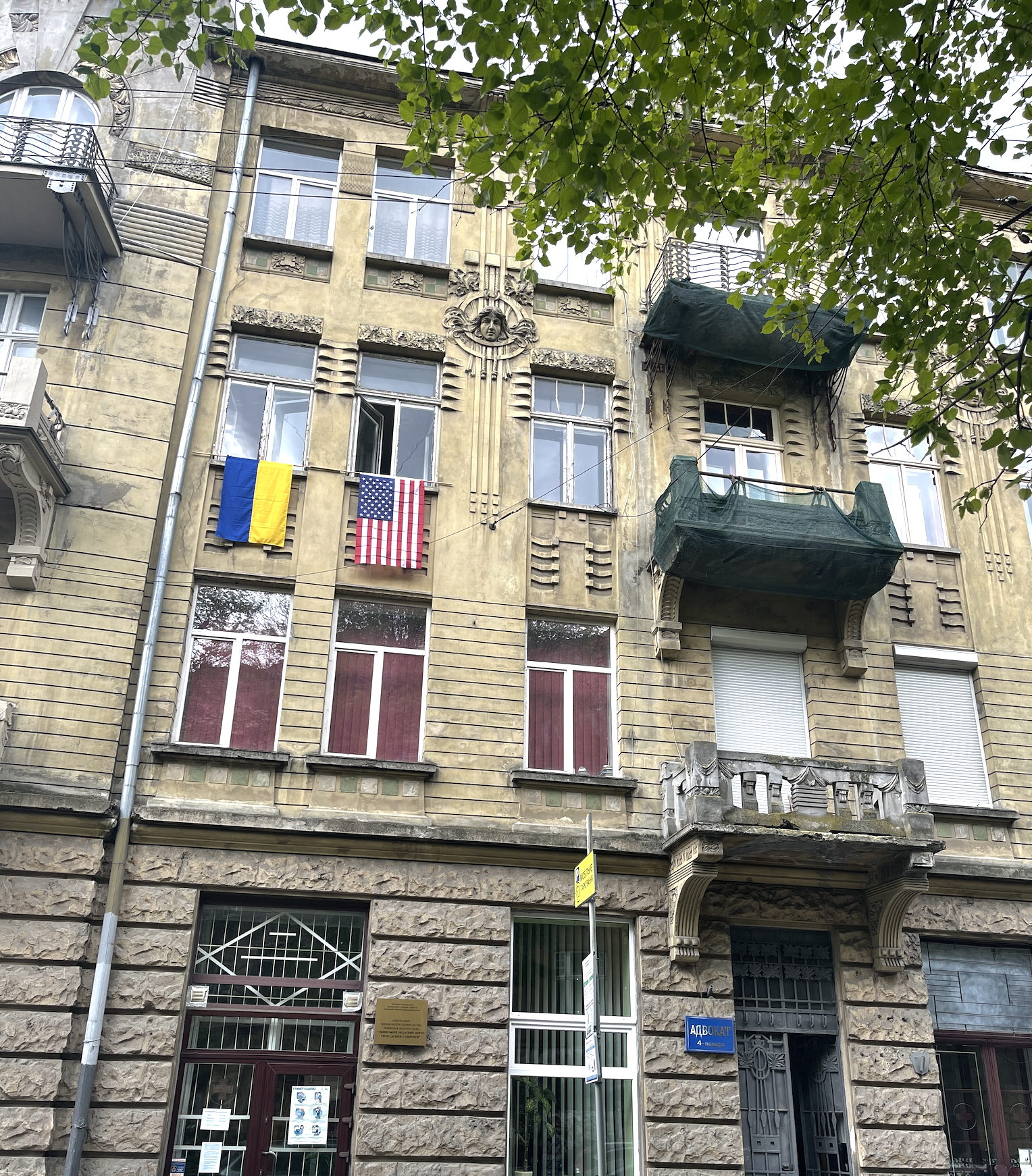
But the need was far, far greater than design. Shelters were overflowing in the city of Lviv, a beautiful gem of a town that can be considered the capital of Western Ukraine. Aswar got in touch with Misha, a volunteer at these shelters who is currently service in the Ukrainian Army, risking his life to protect his homeland.
Misha and Aswar set up an office in Lviv, under the sound of air raid sirens, receiving people and guiding them to options for refuge both in the city, and across the border in Poland.
Then, the Biden Administration, in an immense act of grace and in support of our European allies being overwhelmed by the crisis, welcomed Ukrainian refugees to apply for safety in America. Aswar and Misha knew their job: they would be the main point of contact for the tens of thousands of internally displaced Ukrainians going through Lviv who would seek refuge in America. We named our office on Levytskoho Street “the American Service in Ukraine”.
An unintentional refugee resettlement expert.
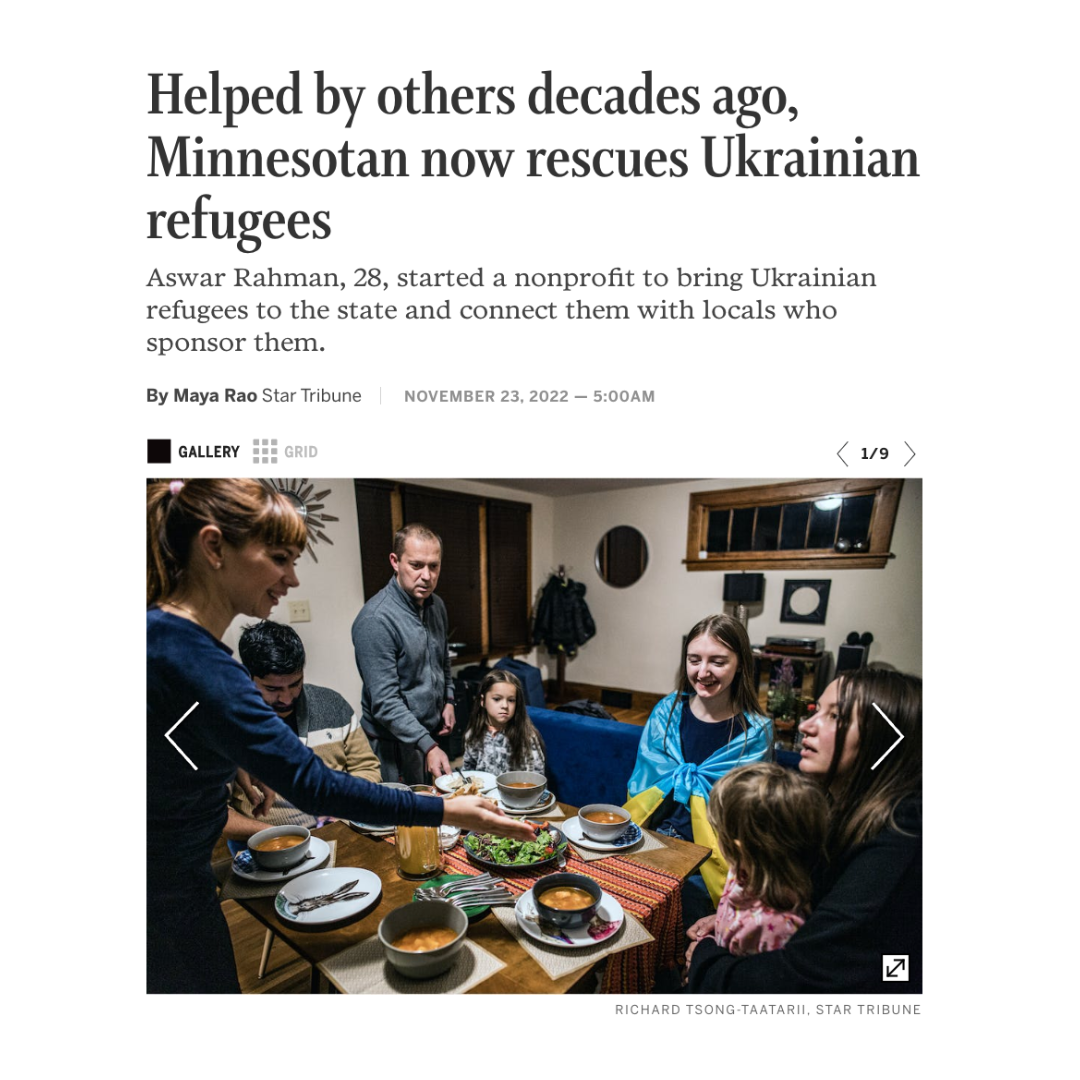
Aswar flew back to America that summer, to prepare the landing spot for the Ukrainians on their way through the office in Lviv. Very quickly, he saw that the refugee reception and resettlement system in the United States was extremely fragile, if not already broken.
The core problem he saw was that newcomers, in general, were treated like unthinking children. But the Ukrainians he had met in Lviv whose homes were now under Russian occupation seemed to him to be some of the smartest and hardest working people he had ever met. Aswar went with his gut — he treated the newcomers with the assumption that they could do what his mom did when she came to America with two little kids in tow. He set up English language education programs at his Lviv office, along with drivers license test education, and cultural lessons, covering everything from Americans’ propensity to smile to how to deal with law enforcement.
When Ukrainians arrived in Minnesota, Aswar’s team had job interviews already lined up for them, along with carpool systems, and appointments to go to the bank to set up their own checking accounts. Respect and dignity was the through-line in all of the work of the American Service in Ukraine. And, surprising to many, it worked.
Aswar’s Ukrainians had a near 100% success rate when measured by self-sufficiency. Some newcomers, of course, struggled — they had gone through one of the worst losses a human being can experience: the loss of their home and, in many case, loved ones — but they had a path forward, and place to turn their struggle into a better life.
Heartbroken and on the verge of bankruptcy.
The success of Aswar’s refugee resettlement program led to federal and agency requests for help with newcomers from other countries, mainly Haiti, Venezuela, and Guatemala. Aswar saw the results of what happens when people are not welcomed with the respect and dignity. Many families had been living in urban shelters for over a year, with no end in sight. Many were convinced that there was a perfect welfare system that would provide for them, and were not told about the often harsh realities of a market economy like ours. No priority had been given to English education or job training.
In New York City, Aswar launched an asylum application system to get newcomers there on a legal pathway. The conditions there were even worse, with pest-infested motels filled with people who were essentially abandoned, in a place as tough as New York City, no less.
These experiences took a great toll on Aswar. The vast majority of Latin American families coming into the program that was designed for Ukrainian refugees still gained success, but the failure rate started creeping up. Aswar poured his personal funds into supporting the families that were unable to adjust to working life, especially after over a year in the shelter — and families that were heartbreakingly disillusioned by America.
As refugee and humanitarian numbers settled, Aswar found himself on the brink of bankruptcy. His business had taken a major hit. He had personally supported too many families with their rent and transportation expenses. Donor and government support that was promised came later and later, and in certain cases stopped altogether.
After three years, having directly and indirectly resettled thousands of refugees, and not having the money needed to pay for his wedding and having his car reposessed, Aswar decided it was time to step back, and focus on rebuilding his own strength.
A revolution in Bangladesh and an international trade business.
In July 2024, a student-led revolution erupted in Aswar’s birth country of Bangladesh. When that country’s dictatorship turned off the internet, all Bangladeshi-origin people around the world knew that the violence would reach a horrifying level. Aswar immediately set about organizing an anti-dictatorship campaign in Minnesota’s small Bangladeshi-American community.
As the crisis went on, Aswar went to New York City, where over half of Bangladesh-Americans live, to organize in force. We took over Times Square, made highly-visible boycotts against garments retailers funding the regime in Bangladesh, and after a month of bloodshed, the revolutionaries in Bangladesh won.
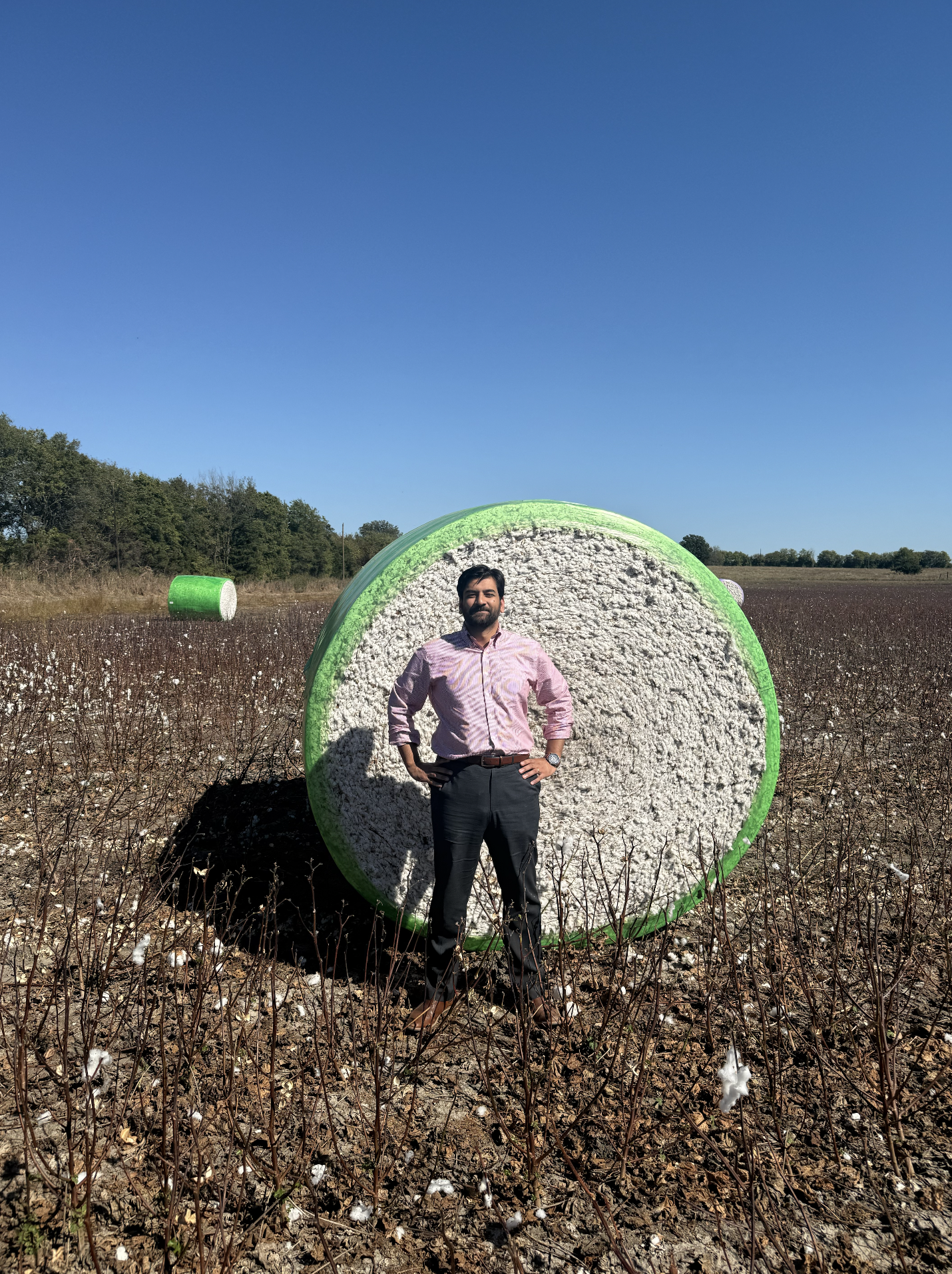
Aswar became fascinated by Bangladesh, especially in its relationship to the world. A young, energetic country moving out of poverty, based heavily on garments production, particularly cotton garments. Bangladesh was fast becoming the largest cotton importer in the world. And, Aswar was surprised to learn, America happened to be the largest cotton exporter in the world. The two, however, did little trade with each other on this commodity, with US cotton account for less than 10% of Bangladesh’s cotton imports.
Aswar flew down to Savannah, Georgia, drove out to rural cotton fields with no experience or connections, and simply approached cotton farmers to learn more about how their business works. He then went out to Bangladesh, to the mills that use the cotton, to learn about their business. He kept going back and forth between home in Minnesota, the cotton fields of the South, and the factories of Bangladesh, on the other side of the planet.
He found, much like he had seen in refugee resettlement, that aging institutions in the cotton trade had slowly crumbled onto each other to create a highly inefficient and costly procurement system, and that American cotton in particular was disadvantaged by this system.
Aswar created the AmeriBangla Corporation in October 2024, and started offering direct-from-farmer American cotton to Bangladeshi spinning mills. As of the present moment, AmeriBangla sends multiple shipments per month through its “pipeline”, with the potential to supply a majority of Bangladesh’s cotton.
ICE'S ATTACKS IN MINNESOTA HAS GOTTEN ASWAR INTO THIS RACE — HIS COMBINATION OF EXPERIENCE AND EFFORT MAKES HIM READY TO LEAD FROM DAY ONE.
PROSECUTE + ABOLISH ICE WITH CONGRESSIONAL AUTHORITY
We are going to fight back against the ICE attack on our communities that have resulted in murders, abductions, and gross violations of the Constitution. We're going to do this by unleashing the full force of Congressional authority. Congress made ICE. Only Congress can hold it accountable. And only Congress can end it.
REDESIGN OUR REFUGEE + IMMIGRATION SYSTEMS TO LAST
We got to this point because (1) there's straight up evil people in power, and (2) because we've punted on real immigration reform for a whole generation.
Aswar has resettled thousands of families fleeing frontlines in Ukraine and societal collapse in Latin America. He's got what it takes to lead the charge to build a refugee and immigration system that will survive extremist attacks going into a wild future.
A TRUE DFL-ER COMMITTED TO RECLAIMING THE AMERICAN DREAM FOR ALL OF US
Aswar is the fighter and champion that our district needs. While middle-ground politicians hope that radical extremists will suddenly come to their senses, Aswar knows that you can't compromise with bullies. Read where he stands on the issues — he'll stand for what believes in, always.